
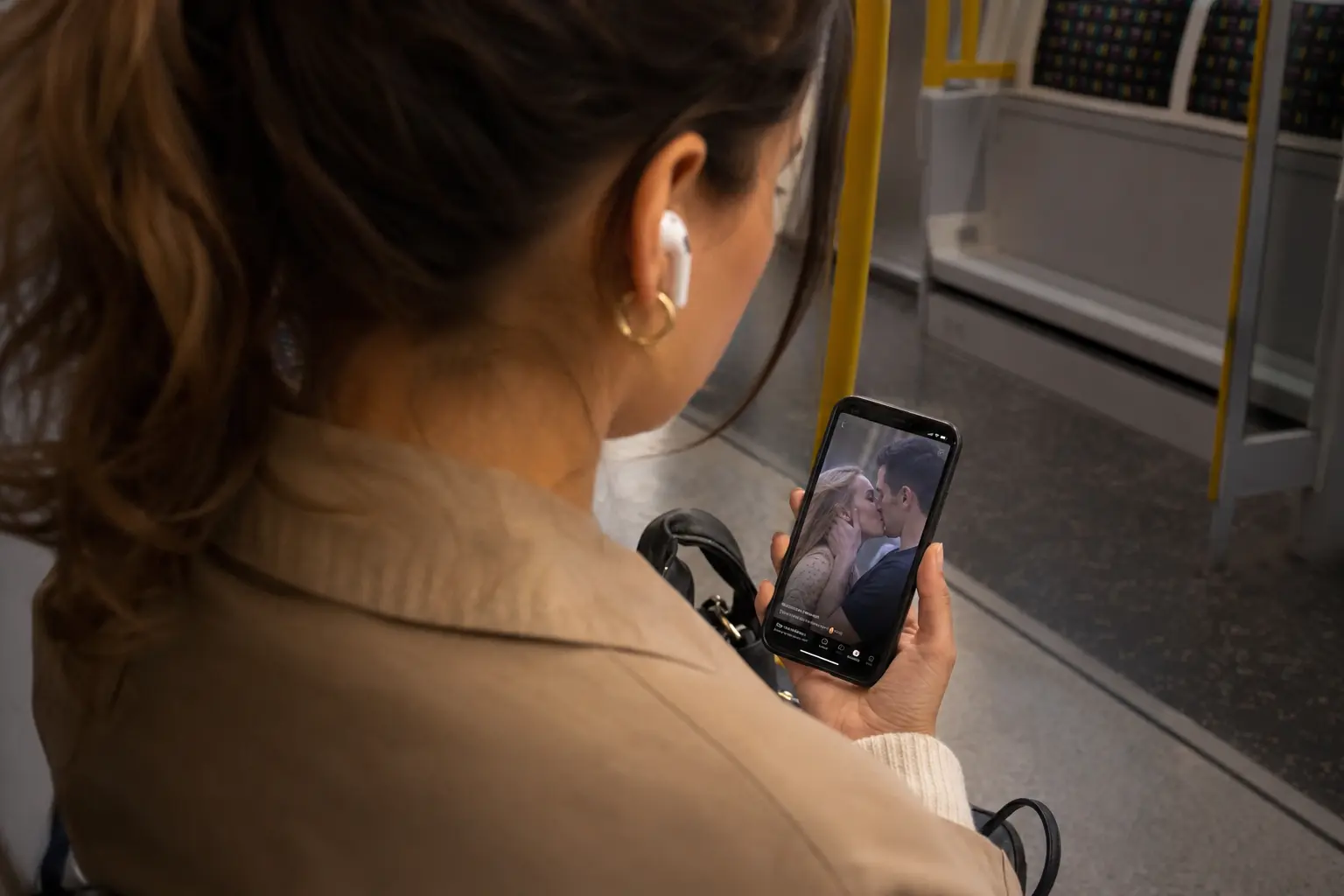
A micro drama — also known as a mini drama, vertical drama, or vertical video series — is a serialized short-form format made up of one- to three-minute episodes, shot in vertical 9:16 format specifically for viewing on a smartphone. Rather than following the conventions of classic series length, the format relies on radically condensed storytelling.
What only a few years ago was dismissed as a niche phenomenon from China has since become one of the most important new media trends: global micro-drama monetization is projected to reach roughly 26 billion US dollars by 2030 — growth that is now catching the attention of broadcasters, streamers, and brands in Germany as well.
Duanju: The Origins and History of Micro Drama
The format has its roots in China, where it has formed its own multi-billion-dollar market for several years under the term „Duanju“ (短劇, Chinese for „short drama“).
The boom is being driven by specialized streaming apps such as ReelShort and DramaBox, as well as platform ecosystems like Douyin and Kuaishou, which not only distribute short dramas but actively co-produce them through partnerships with their own studios.
While in China such formats already account for the majority of overall video viewing time, the share in Europe and North America remains considerably lower — though it is clearly trending upward.
What sets micro dramas apart from earlier web series is above all the use of artificial intelligence: AI is now deployed specifically for dubbing, dramatization, and tagging, shaping the production pace and logic of the entire genre.
What Themes and Subjects Do Micro Dramas Cover?
In terms of content, micro dramas follow a clearly recognizable pattern of recurring genre material: dark romance, billionaire and CEO plots, mafia stories with dark secrets, as well as fantasy and werewolf romance built around „enemies-to-lovers“ dynamics, are among the most popular subjects.
Even the titles — such as „Mafia’s Tender Torture“ or „Love Again, My Princess“ — reveal the underlying principle: terms like „billionaire,“ „boss,“ „marriage,“ „secrets,“ or „betrayal“ appear in most productions because, according to experience, they drive especially high click-through rates.
Narratively, many of these series draw on the tradition of the telenovela and are aimed primarily at a young, female audience that can quickly identify with the heightened conflicts and relationship drama.
Overview of the Most Popular Vertical Drama Genres
| Genre/Subject | Typical Plot Patterns | Example Titles |
|---|---|---|
| CEO & Billionaire Romance | Contract marriage, a wealthy partner’s secret identity, double life, class differences | »The Double Life of My Billionaire Husband« |
| Mafia & Boss Dramas | Forced marriage to a mafia boss, power struggles, dark secrets | »Mafia’s Tender Torture«, »My Mafia Don« |
| Rebirth & Revenge | Betrayal, a second life, targeted retribution against adversaries | »99 rebirths, everyone hates me«, »Divorced, She’s Actually A Legend« |
| Werewolf & Fantasy Romance | „Fated mate“ trope, supernatural powers, enemies-to-lovers | »Married to the secret Lycan King«, »The Alpha’s Hidden Heir« |
| Family & Inheritance Dramas | Inheritance disputes, disowned children, family intrigue | »After becoming a wicked mother-in-law, I won without lifting a finger« |
| Historical & Palace Romance | Court intrigue, arranged marriages in a historical setting | »The Heiress Who Inherited A Prince« |
| Sweet Romance („Sweet Pet“) | Restrained emotional development, slow-burn tension building toward a confession | »Hears My Thoughts, Holds My Heart« |
What Dramaturgy Do Micro Dramas Follow?
The dramaturgy of micro dramas is consistently tailored to the smartphone and to the viewing context of the scrolling feed: characters and conflicts are established within seconds, and every scene ends on a cliffhanger. One could even speak of a radicalized „talking heads“ aesthetic, in which intimacy and emotion take precedence over visual complexity — scenes are not elaborately broken down into evocative imagery.
This structure is no accident; it is built directly around the freemium revenue model. The first episodes run for free to hook the audience on the plot, before the real escalation is placed behind a paywall.
Equally notable is the data-driven narrative logic behind many productions: comments, watch time, and shares feed in real time into decisions about plot twists, character development, or whether a given season gets extended — the audience, in effect, helps write the story.
At the episode level, this narrative logic follows a very precise pattern with clearly defined dramaturgical building blocks:
The hook (first 3–5 seconds): every episode must immediately deliver a visual or narrative jolt — a conflict, a shocking statement, or a reaction dramatic enough to stop the scroll. Without the hook, the episode is lost.
Conflict built into the premise rather than generated through scenes: the conflict is already embedded in the premise itself (e.g., „ruthless tycoon vs. underdog“), rather than emerging from misunderstandings that build up over several scenes — there simply isn’t the narrative time for that.
Escalation instead of exposition: the middle section delivers physically tangible obstacles rather than explanatory dialogue — every line must either advance the conflict or show a character under pressure.
The cliffhanger as the actual product: the final seconds are not merely a stylistic device but the core of the episode — an interrupted sentence, a decision moments before it’s finalized, a revelation on the verge of tipping over.
Paywall-driven dramaturgy: the strongest cliffhangers are deliberately placed just before the paywall to maximize conversion.
Re-entry logic: the opening seconds of each new episode rapidly re-establish the starting situation, since many viewers were interrupted along the way or are joining partway through the season.
Season architecture in blocks: a season with 60 to 100 episodes is organized into clear phases — a free entry point, the first paywall, mid-season turning points, acceleration, resolution — with each twist recharging the story and raising the stakes.
In concrete terms, the dramaturgical pattern across a season often looks like this:
Episode 1 opens with a teaser that already previews the most dramatic moment of the entire season, then jumps back to the actual starting point of the story and builds the conflict up to a first cliffhanger.
In the free episodes that follow, the core conflict intensifies in small, clearly recognizable steps — new information, unexpected encounters, budding jealousy or threats — with each episode ending on its own open beat to strengthen the audience’s attachment to the format.
Just before the first paywall (typically around episode 10 to 15), the season’s strongest cliffhanger to date appears, designed to maximize conversion to paid continuation.
In the middle stretch of the season, turning points, betrayals, and new alliances shift the story’s balance, while parallel subplots — family, rivalry, secret identity — grow increasingly dense.
In the later episodes, secrets are revealed and alliances shift, before the finale brings all storylines together in a showdown that frequently circles back to the teaser image shown at the very start of episode 1.

On Which Platforms Can Micro Dramas Be Found?
The market’s central players remain based in China: apps such as ReelShort and DramaBox serve as specialized distribution channels for vertical series, while platform ecosystems like Douyin and Kuaishou further drive the trend through their own production partnerships. Alongside these, Dailymotion has established itself as an important Western distribution channel for micro dramas: numerous channels such as „Vertical Drama Hub“ or „ReelShort Drama Collection“ distribute curated episodes there, often as a free secondary release running alongside the paid original apps.
For users, though, this doesn’t just mean simple, ad-free access — in relevant communities, there is also ongoing discussion of ad overload and the difficulty of finding individual series on the platform.
TikTok plays another central role, with its algorithm specifically driving reach for new productions, as shown by the example of the ARD production „Between the Beats,“ which was released exclusively on the platform.
The ecosystem is further rounded out by additional apps such as NetShort, MoboReels, or GoodShort, which are increasingly competing for market share in the growing vertical drama segment.
How Streamers and Others Are Adopting the Format
The genre has long since made its way beyond China as well. Disney now uses the format to distribute short versions of already well-known series within the social media universe, while in the US, the film industry has also discovered the potential of cheaply produced verticals.
In Germany, the ARD production „Between the Beats“ by Radio Bremen is by far the most prominent example to date: as the first vertical drama produced by a German public broadcaster, the teen soap runs exclusively on TikTok.
The production industry is following suit as well: Constantin Entertainment, under Otto Steiner, is entering the business with initial pilot productions aimed at the Asian market; Banijay Productions Germany is producing a new-adult format featuring high-reach German creators; and Black Forest Studios in Freiburg-Kirchzarten has been a specialized German producer for the genre since as early as 2020.
In Munich, meanwhile, the newly founded Vertical Minds is working on a platform called EILIN, intended to specifically offer vertical series of German origin.
The format is becoming interesting for brands as well: companies such as AEVOR, Maybelline, and Starbucks are already making targeted use of serialized micro-content formats for their brand communications.
Challenges, Monetization, and Current Debates
Despite its rapid growth, the micro drama market is still shaped by open questions.
When it comes to monetization, various models are competing with one another — pay-per-episode, freemium with a subscription component, micropayments, and brand integrations — without a clear standard having yet emerged for the German and European markets.
There is also a fundamental debate about quality: critics fear the format may remain limited to purely „snackable“ entertainment rather than developing genuine dramaturgical and visual potential — a question that remains openly contested.
Another challenge is strong platform dependency: reach and visibility depend heavily on algorithms such as TikTok’s, as well as on third-party platforms like Dailymotion, leaving producers with significant loss of control over distribution and revenue.
The growing use of AI in conception and production — ranging from automated dubbing to fully AI-generated series such as „Aminho The Challenge“ — also raises new questions around quality and authorship.
Finally, it remains an open question just how culturally transferable narrative patterns originating from China really are for the European market: industry voices anticipate that, in this region, more sophisticated, locally rooted content with international appeal will ultimately prove most successful. It remains an exciting space to watch.
FAQ
Is „micro drama“ the same as „vertical drama“?
Yes, the two terms are used largely synonymously within the industry. „Vertical drama“ tends to emphasize the technical feature of the vertical (9:16) format, while „micro drama“ places more emphasis on the extremely short episode length.
How long is an episode, and how many episodes does a season have?
A single episode typically runs 60 to 180 seconds, with around 90 seconds being common. A complete season generally comprises 60 to 100 episodes, which in total adds up to roughly the length of a feature film — just broken down into tiny, individually watchable pieces.
How much does it cost to produce a micro-drama series?
Depending on scope and production values, the cost of producing a complete series of around 20 to 30 episodes typically falls in the low six-figure euro range — considerably cheaper than a single hour of a classic German TV production.
Who watches micro dramas?
The audience consists predominantly of young, female viewers who consume telenovela-style relationship dramas — often in short pockets of everyday time, such as at the bus stop or in a waiting room.
Is the format being seriously produced in Germany too, or is it just an imported trend?
Both: alongside licensed or adapted Chinese material, genuinely German productions are now also emerging — from companies such as Constantin Entertainment, Banijay, and Black Forest Studios — with the explicit goal of telling more sophisticated, locally rooted stories.
Schreibe einen Kommentar